




We replace them ASAP. No cost, almost no waiting, no disruption. Your Customer Success Manager handles the transition so you don't miss a beat. That's our guarantee.
Most business owners wait too long. They spend months — sometimes years — doing work that doesn't require their expertise, watching their calendar fill with tasks that have nothing to do with growth. Then they burn out, miss opportunities, or both.
A virtual assistant doesn't solve every problem. But for the right business owner at the right stage, hiring a VA is one of the highest-leverage decisions they can make. This article explains why — and how to know if you're there.
The Core Problem: Owner Time Is Finite
Every business owner has the same constraint: 24 hours in a day. The question isn't whether you have enough to do — it's whether the things consuming your time are actually the things that grow your business.
Most aren't. Research consistently shows that executives and business owners spend a significant portion of their week on tasks that could be delegated — email management, scheduling, data entry, reporting, customer inquiries, social media, bookkeeping. These tasks are necessary. They're just not the best use of your time.
A virtual assistant takes that work off your plate. Not so you have nothing to do — so you can do the work that actually moves the needle.
7 Reasons to Hire a Virtual Assistant
1. You're Doing Work That Doesn't Require You
This is the clearest signal. If you're spending time on tasks that any competent person could handle — scheduling meetings, responding to routine emails, updating spreadsheets, posting to social media — you're the most expensive person in your business doing the cheapest work.
A VA handles that layer. You get your hours back for client work, strategy, sales, and the decisions only you can make.
2. You Can't Scale Without More Hands
Growth creates volume. More customers mean more inquiries, more orders, more follow-ups, more administrative work. If you're the bottleneck — the person everything flows through before it gets done — your business can't grow faster than your personal bandwidth.
A VA extends your capacity without the overhead of a local hire. You can take on more clients, move faster, and respond better — without burning out trying to do everything yourself.
3. Local Hiring Is Too Expensive
A full-time in-house employee in the US costs $45,000–$90,000 in salary depending on the role and market — and that's before benefits, payroll taxes, workers' compensation, office costs, and management overhead. For many small businesses, that math simply doesn't work.
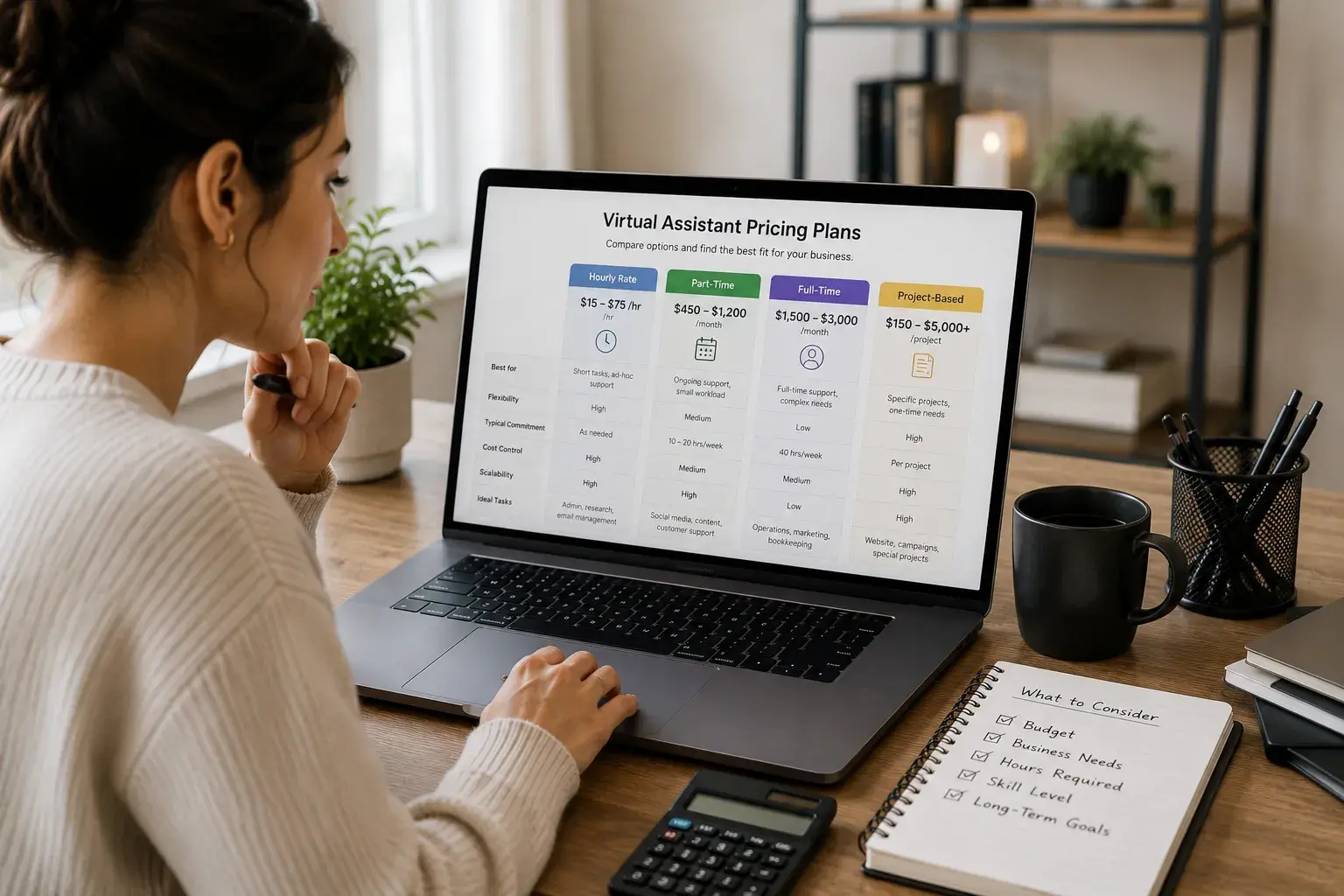
A dedicated, full-time virtual assistant through an agency like Stellar Staff starts at $1,599/month — roughly $19,000 per year. Same hours, same commitment, a fraction of the cost. The savings aren't marginal. They're transformational for a business watching its margins closely.
4. You Keep Dropping Balls
When you're doing everything, things fall through the cracks. Follow-ups that never happen. Invoices that go out late. Customer inquiries that sit unanswered for two days. Appointments that weren't confirmed. These aren't character flaws — they're the predictable result of one person managing too much.
A VA creates the operational structure your business needs. They own the tasks they're assigned and make sure nothing gets missed. Your business runs tighter because someone is specifically responsible for keeping it that way.
5. You Want to Focus on What You're Actually Good At
Most business owners started their company because they're good at something — a craft, a skill, a service, a product. Over time, the business grows and the owner spends less and less time doing the work they're actually great at, and more time on the administrative and operational layer that surrounds it.
A VA gives that back to you. You do the work you're best at. They handle the infrastructure around it.
6. Your Customer Experience Is Suffering
Slow response times, missed calls, delayed follow-ups — these erode customer relationships and kill referrals. In competitive markets, responsiveness is a differentiator. Businesses that respond within minutes win more than businesses that respond within hours.
A customer service VA handles inquiries, follows up with leads, manages your inbox, and makes sure every customer interaction gets a prompt, professional response. That consistency compounds over time into a reputation for reliability.
7. You're Working Nights and Weekends to Keep Up
If the only time you can do strategic work is after 9pm because your days are consumed by operational tasks, that's a clear sign you need support. Working nights and weekends to keep a business afloat isn't hustle — it's a structural problem. A VA fixes the structure.
What Can a Virtual Assistant Actually Do?
The scope is broader than most business owners expect. A well-matched VA can handle:
Administrative work: Email management, calendar scheduling, travel booking, document preparation, data entry, and general office operations — the essential layer that keeps your day organized and your operations running smoothly.
Customer service: Handling inquiries, complaints, live chat, appointment scheduling, billing questions, and follow-ups across email and phone. A customer service VA keeps your customers happy without pulling you into every interaction.
Bookkeeping and finance: Recording transactions, reconciling accounts, processing invoices, tracking expenses, and preparing financial reports. A bookkeeping VA keeps your numbers organized so you're not scrambling at tax time.
Marketing: Email campaigns, content scheduling, campaign coordination, and marketing operations. A marketing VA handles the execution layer of your marketing without you needing to hire a full in-house team.
Social media: Content creation, scheduling, community management, analytics, and engagement. A social media VA keeps your brand active and consistent across platforms without it consuming your time.
Sales support: Lead follow-up, CRM management, outbound prospecting, and pipeline maintenance. A sales VA keeps deals moving so nothing stalls in the pipeline.
Specialized functions: Real estate, legal, medical, insurance, finance — many industries have specific administrative needs that experienced VAs handle with familiarity. Stellar Staff places VAs across all of these verticals.
The Difference Between a VA and a Freelancer
This distinction matters. A freelancer on Upwork or Fiverr is a transactional relationship — you post a task, someone completes it, you move on. There's no continuity, no investment in your business, no institutional knowledge built over time.
A dedicated virtual assistant is different. They work full-time, exclusively for your business. They learn your systems, your preferences, your brand voice, your workflows. Over weeks and months, they become genuinely capable of anticipating your needs rather than waiting to be told what to do.
That depth of familiarity is what makes the difference between a VA who saves you 5 hours a week and one who transforms how your business operates.
Why the Vetting Process Matters
Not all VAs are created equal. The quality of your experience depends heavily on how rigorously the company vetted the person they placed with you.
At Stellar Staff, every VA goes through 24 application steps and 40+ hours of screening and training before a client ever meets them. The acceptance rate is 0.1%. You're not choosing from a large pool of applicants — you're interviewing a small number of pre-validated candidates who have already proven they can do the work.
That selectivity is what makes the model reliable. It's why Stellar Staff clients — from franchise operators to healthcare founders to real estate teams — report 98% satisfaction and stay long-term.
How to Know If You're Ready to Hire a VA
You're ready when:
- You regularly run out of time before you run out of work
- You're doing tasks you know you shouldn't be doing
- Customer response times are slipping
- You've turned down business because you didn't have bandwidth
- You're working evenings and weekends just to keep up
- You've thought "I just need someone to help me" more than once this month
You're not ready when:
- You don't have clear tasks to delegate yet
- Your processes are so undefined that you can't explain what you need
- Your budget genuinely doesn't allow for it
If you're in the first category, the cost of waiting — in lost time, lost opportunities, and lost energy — is higher than the cost of hiring.
What the First 30 Days Look Like
The first month with a new VA is an investment in onboarding. You'll spend time explaining your systems, your preferences, and your workflows. Most clients find this takes less time than expected — especially when the VA has been well-matched to their needs.
By the end of the first month, a good VA is handling their assigned responsibilities with minimal supervision. By the end of the second month, they're anticipating what you need before you ask.
The compounding effect of having a great VA is real — but it starts with getting the right person in place.
Ready to Hire?
Stellar Staff matches you with a dedicated, full-time virtual assistant in 5–6 days. Every candidate has cleared 24 application steps and 40+ hours of training. You interview, you choose, they start.
See what business owners say after making the hire — then get started here.